Fin MacDonald

Information on me and my current projects

Category Archives: Nova Scotia Community College

Empowered Partnership – Success Magazine 2011

Each year NSCC puts out Success Magazine to publicize recent projects among students and staff. This year a project involving our lab was selected for printing! Dr. Alain Joseph who heads the Applied Energy Research Lab obtained a grant through NSERC (Natural Sciences and Engineering Council of Canada) to work to improve the performance of solar energy systems in Atlantic Canada. Dr. Joseph hired 8 students to help with the project over the course of the year. Travis Keeping from the Electrical Engineering Technology program and his instructor Gord Wilkie helped design a Programmable Logic Controller (PLC) to monitor solar hot water. The monitoring system was deployed in industry and will provide clues to the availability of solar energy in our climate. Since I came on late in the project my work involved examining low cost alternatives to the PLC system. My work using the Web Energy Logger (WEL) was based around trying to provide the same information as the PLC system. I believe it is important to have low cost alternatives because not every system is big enough to warrant the expense of PLCs which can be in the range of thousands of dollars. We are currently deploying both a PLC system and a low cost WEL on the solar equipment on the roof of the Waterfront Campus.

I have attached a scan of the article here.

Congratulations to NSCC Graduates 2011

I would like to take a minute to congratulate the graduates of NSCC this year. My campus in Middleton, NS had their graduation on Friday. The Waterfront Campus in Dartmouth where I currently work is having their graduation today. I know first hand the challenges associated with earning your diploma, especially the heavy course load of 6 classes. It is a task that takes hard work and determination.

I would like to thank the Energy Sustainability Engineering Technology graduates in Middleton, NS for being such good role models and mentors to us students in the first year this past year. Hopefully we will be able to provide the same level of support to the new ESET students coming into the program this year.

I wish all graduates the best of luck in their future endeavors!

NSCC Waterfront Solar Monitoring (Part 1)

We are working on an electronic monitoring system for the solar thermal gear on the roof of the NSCC Waterfront Campus. The roof has 2 arrays of Thermodynamics flat plate collectors as well as 2 arrays of Thermomax evacuated tube collectors. We will be monitoring the glycol temperatures, outside air temperature, and solar radiation. The data logging will be done using the Web Energy Logger (WEL) over the Wel Server. I have installed the temperature sensors and programmed the logic for the calculations inside the WEL. We are interested in adding flow meters to this project if we can find ones within our price range and get permission from facilities management to install them.

The challenge with working on the roof is that there isn’t power or wired network access. The campus has a very weak wireless signal on the roof and I will be connecting the WEL to the internet that way by using a wireless bridging router. The router runs off 12V and the WEL can also run off of 12V. For now I will power the entire setup off of a large deep cycle battery and it will need to be changed and charged from time to time. NSCC Applied Research may add a photovoltaic panel to the roof to power the equipment and charge the battery at a later time.

This project is unique from the residential and commercial installs I have done in the past because it will be used primarily for research. An electronics student at the college was able to design us a voltage to milliamp converting circuit board that will allow us to connect a pyranometer with a voltage output to the 4-20 mA input on the WEL. By using a pyranometer and air temperature sensor I will be able to match the energy output to the solar radiation and determine the energy efficiency of the gear. I will also be able to do statistical analysis over time. The lab will be very interested in the variance of the different readings and how they relate to each other. By comparing sunny days in the winter to days with the same amount of solar radiation in the summer we will be able to determine the effect of outside air temperature on the output of the different types of collectors. This is of particular interest because our winters are cold but the sun is usually shining.

I will be posting more information as this project progresses.

20110606-035558.jpg

The Thermomax evacuated tube collectors are the dark blue tubes on the left of the roof. The Thermodynamics flat plat collectors are the small grey rectangular panels with the black border.

Solar Pathfinder vs Solmetric iPV

Today I conducted a little test to compare the performance of two low cost solar site assessment tools. I consider low cost to be anything under $1,000. These tools provide infomation about the amount of available sunlight that falls on a surface. They do this by examining the landscape features in the area that provide shade at different parts of the day such as buildings and trees. These tools provide a percentage of available solar radiation you can expect to receive. This can then be combined with weather data and solar panel information to perform preliminary energy calculations using energy modelling software. This site assessment information is supplied for each month however for the purpose of this test I am only going to compare the total annual values.

The two tools I compared are:

1) Solar Pathfinder (http://www.solarpathfinder.com) $299 + $199 software
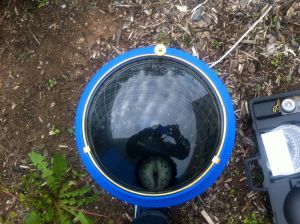
Solar pathfinder image. The black areas inside the ring mark the obstructions in the surrounding area. This image is traced using computer software.

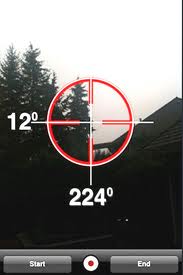
2) Solmetric iPV iPhone application (http://www.solmetric.com/solmetricipv.html) $29.99

The Solmetric app lets you trace the obstructions directly with the iphone.

The calculations for the percentage of available sunlight were as follows:

Solar Pathfinder: 84%
Solmetric iPV: 86%

Both of these tools require tracing so they have a element of human error involved. When using the pathfinder you take a picture of the equipment and trace it using the computer software. When using the Solmetric app you trace the horizon directly with the iphone. Given the close proximity of the results I don’t really feel as though one is any better than the other from a performance standpoint. When you consider the price the Solmetric iPV iPhone application is the clear winner, but only if you already own an iPhone.

Solmetric also makes professional site assessment tools in the $2,000 price range that do not require any manual tracing and are remarkably accurate.

Governor General’s visit to NSCC Waterfront Campus

Today was an interesting day at the lab as the Governor General of Canada came to visit the campus. His Excellency the Right Honorable David Johnson replaced Michaëlle Jean in 2010. He didn’t have time to stop in and talk with us in the Applied Research lab but he did take a few minutes to view the renewable energy gear on the roof. The day today was largely unproductive and filled with anticipation. I’m sure it was this way for most of the staff today, but how often do you really have such an important guest? I snapped this picture of him on his tour of the building.

The Governor General of Canada on his tour of the NSCC Waterfront Campus

Web Energy Logger installation today

Today I installed a web energy logger on a solar thermal system in Halifax. The system is in a large multi-floor residential building. The entire process took about 3 hours, which is a new record for me. The solar data logging system installed has 5 temperature sensors and a current switch to detect if the pump is on. With this setup we are able to calculate the amount of energy that the solar panels are able to extract from the sun and supply to the glycol. The data logger will provide real time data once each minute as well as log the data to a .csv file for analysis at a later time. It connects to the WEL Server (www.welserver.com) to transmit the data over the internet.

The limitation of this data logging system configuration is that it is unable to calculate how much of that energy is actually transferred to the water. Since the solar system was already installed prior to the decision to add a data logger, it does not have electronic pulse flow meters. Flow meters connected to the data logger would allow for accurate calculations of the energy supplied to residents and the savings on the buildings power bill associated with that energy. The decision to go back and install pulse flow meters will rest with the building owner.

1st Year of ESET Complete

Today marks the end of my first year of the Energy Sustainability Engineering Technology program at NSCC. I am officially done for the summer and eligible for employment. I finished my work term working with NSCC Applied Research. I am hoping to be hired on with them for the next month and should find out soon. I will still need a job for the tail end of the summer.

The ESET program at NSCC has opened my eyes to the growing market for Green. Green construction and green energy markets are growing incredibly fast. The skills I have learned in my first year of the program include:

– Energy auditing
– Energy modelling
– Renewable energy assessments
– Drafting in AutoCAD and Google Sketchup

The Web Energy Logger (WEL)

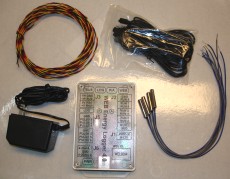
The WEL is a low cost but effective data logger that can be used to monitor energy use or generation. It contains a one wire bus that allows digital sensors to be strung along like christmas tree lights. It also contains 6 pulse inputs, 8 run inputs, and 2 4-20 mA analog inputs. Pulse sensors return an electronic pulse signal and applications may include paddlewheel flow meters for water flow. The digital pulses can be counted and converted into a volume flow rate. Run sensors tell you if the device connected is on or not. Current switches can be installed over power cables to current and return an on/off signal. 4-20 mA sensors send a mA current signal that can be scaled into engineering units.

Inside the WEL you are allowed 150 variables. These can be sensor inputs, constants, or simple expressions of other variables. The WEL has limited internal memory so it is limited to simple 2 variable expressions and is not capable of doing exponents or square roots. That being said most energy calculations can still be performed inside the WEL. It also has support built in to maintain running totals for the day, month, or year of any variable.

The WEL uses a rabbit board network chip to connect to the internet and transmit the data. It can be set to log data at any frequency, entered in minutes. By default it connects to the WELserver (http://www.welserver.com). This webpage contains a map of the world with all the other WEL’s shown on it. It is a great tool because it allows you to not only monitor your system, but see how others are doing as well. With some ingenuity you can connect the WEL to your own server to record and present the data there. The WEL posts data that can be received by a simple CGI or PHP script.

Typical WEL applications include monitoring of geothermal, solar thermal, solar photovoltaic, and energy use. The WEL is diverse enough to be used in other applications as well. A device called the WattNode (http://www.ccontrolsys.com/w/Advanced_Pulse_WattNode) must be added if you want to measure alternating current.