Fin MacDonald

Information on me and my current projects

Monthly Archives: June 2011

Congratulations to NSCC Graduates 2011

I would like to take a minute to congratulate the graduates of NSCC this year. My campus in Middleton, NS had their graduation on Friday. The Waterfront Campus in Dartmouth where I currently work is having their graduation today. I know first hand the challenges associated with earning your diploma, especially the heavy course load of 6 classes. It is a task that takes hard work and determination.

I would like to thank the Energy Sustainability Engineering Technology graduates in Middleton, NS for being such good role models and mentors to us students in the first year this past year. Hopefully we will be able to provide the same level of support to the new ESET students coming into the program this year.

I wish all graduates the best of luck in their future endeavors!

Junior Achievement Nova Scotia Business Hall of Fame

Last night I attended the annual Junior Achievement Nova Scotia Business Hall of Fame gala. As a volunteer with Junior Achievement I am invited to this prestigious event every year. Once a year they get together to induct three new laureates into the hall of fame. The event included a reception and networking period, three course meal, and an awards ceremony.

This years laureates were:

1) Robert (Bob) Kelly, chairman and CEO of the Bank of New York Mellon Corporation

2) Sharon and Richard Calder, founders and owners of Charm Diamond Centres

3) The late Rose Schwartz, co-founder and owner of Schwartz Clothing

The event was hosted by students who took part in the junior achievement program this year, who will likely be the business leaders of tomorrow. Lynn Coveyduck who is the head of JA Nova Scotia presented some interesting research data from the Boston Consulting Group. It turns out that JA students are far more likely to get a college education, earn higher wages, and be successful than those who don’t take the program. We have always known this but thanks to the Boston Consulting Group it is now quantifiable.

I would like to thank all the sponsors of the evening, especially Cox & Palmer who was my sponsor for the evening. All together the event raised over $200,000 for JA Nova Scotia.

NSCC Waterfront Solar Monitoring (Part 1)

We are working on an electronic monitoring system for the solar thermal gear on the roof of the NSCC Waterfront Campus. The roof has 2 arrays of Thermodynamics flat plate collectors as well as 2 arrays of Thermomax evacuated tube collectors. We will be monitoring the glycol temperatures, outside air temperature, and solar radiation. The data logging will be done using the Web Energy Logger (WEL) over the Wel Server. I have installed the temperature sensors and programmed the logic for the calculations inside the WEL. We are interested in adding flow meters to this project if we can find ones within our price range and get permission from facilities management to install them.

The challenge with working on the roof is that there isn’t power or wired network access. The campus has a very weak wireless signal on the roof and I will be connecting the WEL to the internet that way by using a wireless bridging router. The router runs off 12V and the WEL can also run off of 12V. For now I will power the entire setup off of a large deep cycle battery and it will need to be changed and charged from time to time. NSCC Applied Research may add a photovoltaic panel to the roof to power the equipment and charge the battery at a later time.

This project is unique from the residential and commercial installs I have done in the past because it will be used primarily for research. An electronics student at the college was able to design us a voltage to milliamp converting circuit board that will allow us to connect a pyranometer with a voltage output to the 4-20 mA input on the WEL. By using a pyranometer and air temperature sensor I will be able to match the energy output to the solar radiation and determine the energy efficiency of the gear. I will also be able to do statistical analysis over time. The lab will be very interested in the variance of the different readings and how they relate to each other. By comparing sunny days in the winter to days with the same amount of solar radiation in the summer we will be able to determine the effect of outside air temperature on the output of the different types of collectors. This is of particular interest because our winters are cold but the sun is usually shining.

I will be posting more information as this project progresses.

20110606-035558.jpg

The Thermomax evacuated tube collectors are the dark blue tubes on the left of the roof. The Thermodynamics flat plat collectors are the small grey rectangular panels with the black border.

Solar Pathfinder vs Solmetric iPV

Today I conducted a little test to compare the performance of two low cost solar site assessment tools. I consider low cost to be anything under $1,000. These tools provide infomation about the amount of available sunlight that falls on a surface. They do this by examining the landscape features in the area that provide shade at different parts of the day such as buildings and trees. These tools provide a percentage of available solar radiation you can expect to receive. This can then be combined with weather data and solar panel information to perform preliminary energy calculations using energy modelling software. This site assessment information is supplied for each month however for the purpose of this test I am only going to compare the total annual values.

The two tools I compared are:

1) Solar Pathfinder (http://www.solarpathfinder.com) $299 + $199 software

Solar pathfinder image. The black areas inside the ring mark the obstructions in the surrounding area. This image is traced using computer software.

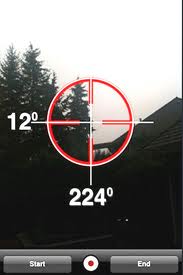
2) Solmetric iPV iPhone application (http://www.solmetric.com/solmetricipv.html) $29.99

The Solmetric app lets you trace the obstructions directly with the iphone.

The calculations for the percentage of available sunlight were as follows:

Solar Pathfinder: 84%
Solmetric iPV: 86%

Both of these tools require tracing so they have a element of human error involved. When using the pathfinder you take a picture of the equipment and trace it using the computer software. When using the Solmetric app you trace the horizon directly with the iphone. Given the close proximity of the results I don’t really feel as though one is any better than the other from a performance standpoint. When you consider the price the Solmetric iPV iPhone application is the clear winner, but only if you already own an iPhone.

Solmetric also makes professional site assessment tools in the $2,000 price range that do not require any manual tracing and are remarkably accurate.

Governor General’s visit to NSCC Waterfront Campus

Today was an interesting day at the lab as the Governor General of Canada came to visit the campus. His Excellency the Right Honorable David Johnson replaced Michaëlle Jean in 2010. He didn’t have time to stop in and talk with us in the Applied Research lab but he did take a few minutes to view the renewable energy gear on the roof. The day today was largely unproductive and filled with anticipation. I’m sure it was this way for most of the staff today, but how often do you really have such an important guest? I snapped this picture of him on his tour of the building.

The Governor General of Canada on his tour of the NSCC Waterfront Campus